
1. Introduction to Information Technology
Information Technology (IT) has become one of the most important parts of modern civilization. It influences communication, education, healthcare, business, entertainment, banking, transportation, and scientific research. Modern computers, smartphones, cloud services, and artificial intelligence are the results of centuries of technological development. The history of IT shows how humans continuously developed better ways to calculate, store, process, and share information.
2. The Beginning of Calculation
The earliest foundations of information technology can be found in ancient methods of counting and calculation. The abacus was one of the most important early calculating tools. It allowed people to perform arithmetic operations more efficiently. Although it was very simple compared with today’s computers, it introduced an important concept: technology could assist humans in processing information and solving mathematical problems.
3. Mechanical Calculators
The development of mechanical calculators was an important step toward modern computing. In 1642, French mathematician Blaise Pascal developed the Pascaline, a mechanical device capable of performing basic arithmetic calculations. Later, Gottfried Wilhelm Leibniz created a more advanced calculating machine that could perform multiplication and division. These inventions demonstrated that machines could reduce human effort in mathematical calculations.
4. Charles Babbage and the First Computer Concepts
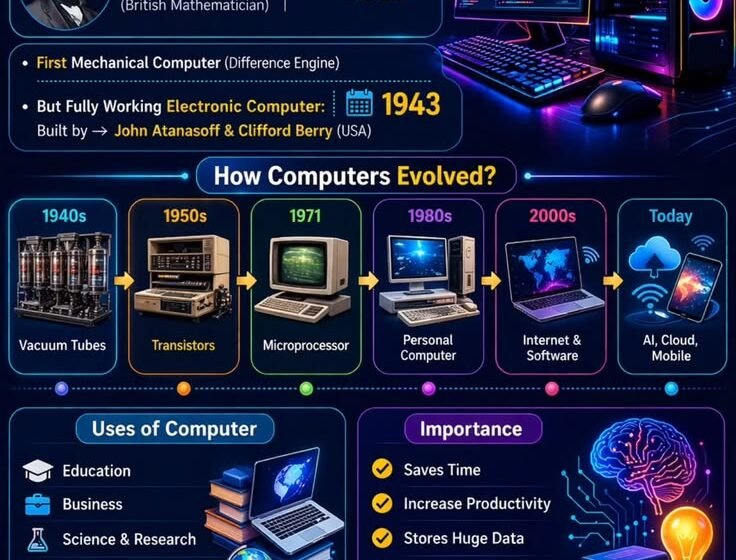
The nineteenth century brought another major development through the work of Charles Babbage. He designed the Difference Engine to perform mathematical calculations automatically. Later, he developed the concept of the Analytical Engine, which included ideas similar to a modern computer, including memory, processing, and programmable instructions. Although the complete machine was never constructed during his lifetime, his designs became an important foundation for computer science.
5. Ada Lovelace and Early Programming
Ada Lovelace played a significant role in the history of computing. While studying Babbage’s Analytical Engine, she understood that such machines could potentially do more than simple calculations. She developed an algorithm designed for the machine and is widely recognized as an early pioneer of computer programming. Her ideas helped establish the concept that computers could follow programmed instructions to perform different types of tasks.
6. The Rise of Electronic Computers
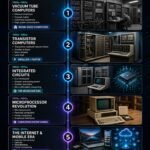
During the twentieth century, computing moved from mechanical systems toward electronic machines. Early electronic computers were extremely large and expensive. They were mainly used by governments, universities, military organizations, and research institutions. Machines such as ENIAC demonstrated that electronic systems could perform complex calculations at speeds far beyond human capabilities.
7. The Invention of the Transistor
The invention of the transistor in 1947 transformed the computer industry. Transistors were significantly smaller, more reliable, and more energy-efficient than vacuum tubes. Their development allowed computers to become smaller and more practical. This innovation eventually contributed to the creation of modern electronic devices and laid the groundwork for the rapid growth of digital technology.
8. Integrated Circuits and Smaller Computers
Integrated circuits represented another major breakthrough. Instead of using separate electronic components, many components could be placed together on a single chip. This reduced the size and cost of electronic systems while increasing their performance and reliability. Integrated circuits became essential to the development of modern computers, communication equipment, and other digital technologies.
9. The Personal Computer Revolution
The 1970s and 1980s introduced a new era of personal computing. Microprocessors made it possible to produce smaller and more affordable computers. Companies such as Apple, IBM, and Microsoft contributed significantly to the growth of the personal computer industry. Computers gradually moved from laboratories and large organizations into offices, schools, and homes.
10. The Development of the Internet
The internet created one of the most significant changes in information technology. Computer networks allowed different systems to communicate and exchange information across long distances. The development of the World Wide Web in the early 1990s made online information much easier for ordinary users to access. Websites, email, search engines, and online services quickly became important parts of everyday life.
11. The World Wide Web
Tim Berners-Lee played a major role in creating the World Wide Web. The web provided a practical way to organize and access information through interconnected pages and links. As web browsers became widely available, millions of people began using the internet for education, communication, shopping, entertainment, and business. The web also created new opportunities for companies to reach global audiences.
12. The Mobile Technology Revolution
Mobile technology changed the way people interact with information. Early mobile phones were primarily designed for voice communication, but smartphones eventually combined calling, computing, photography, internet access, navigation, and entertainment in one device. Today, smartphones provide users with access to information and digital services from almost anywhere.
13. Cloud Computing
Cloud computing introduced a new approach to storing and processing information. Instead of depending entirely on local computers, users can access software, storage, databases, and computing resources through internet-based platforms. Cloud technology has helped businesses reduce infrastructure costs, improve collaboration, and scale their digital operations more efficiently.
14. Big Data and Information Management
The rapid growth of digital services has produced enormous quantities of data. Big data technologies allow organizations to collect, store, process, and analyze information on a large scale. Businesses use data analysis to understand customers, improve services, identify trends, and make better decisions. Data has therefore become one of the most valuable resources in the modern digital economy.
15. Artificial Intelligence
Artificial intelligence has become one of the most important developments in modern information technology. AI systems can analyze information, recognize patterns, understand language, generate content, and assist with complex tasks. Artificial intelligence is being used in healthcare, education, finance, transportation, manufacturing, customer service, and many other industries.
16. The Internet of Things
The Internet of Things, commonly called IoT, connects physical devices to digital networks. Smart home equipment, vehicles, industrial machines, wearable devices, and medical systems can collect and exchange information. IoT technology allows organizations and individuals to monitor systems, automate processes, and make more informed decisions.
17. The Importance of Cybersecurity
As technology has expanded, cybersecurity has become increasingly important. Personal information, financial records, business data, and government systems can be targeted by cybercriminals. Threats such as malware, phishing, ransomware, hacking, and data theft can cause serious damage. Strong security practices, encryption, multi-factor authentication, and regular software updates are essential for protecting digital information.
18. Information Technology in Modern Business
Information technology has completely transformed the business environment. Companies now use digital platforms for communication, marketing, accounting, customer management, online sales, and international collaboration. E-commerce has also allowed businesses to reach customers beyond their physical locations, creating new opportunities for entrepreneurs and established companies.
19. Information Technology in Education
Technology has changed education by providing students with access to digital libraries, online courses, educational applications, and virtual classrooms. Teachers can use multimedia resources to make lessons more engaging, while students can learn from experts and institutions around the world. Digital education has made knowledge more accessible than ever before.
20. The Future of Information Technology
The future of IT is expected to bring continued progress in artificial intelligence, robotics, quantum computing, advanced networks, and automation. These technologies could improve productivity and create new opportunities across many industries. At the same time, society will need to address important challenges involving privacy, cybersecurity, ethical AI, employment, and equal access to technology.
21. Conclusion
The history of information technology is a remarkable journey from simple counting tools to intelligent and globally connected digital systems. Every major innovation has contributed to the next stage of technological progress. Mechanical calculators influenced computer development, transistors enabled smaller electronic systems, microprocessors supported personal computers, the internet connected the world, and artificial intelligence is now creating new possibilities.
Information technology is no longer limited to computers and software. It has become a fundamental part of modern life and continues to influence how people work, learn, communicate, and solve problems. Understanding its history helps us appreciate technological progress while recognizing the responsibility to develop and use technology safely, ethically, and for the benefit of society.