
Introduction
Technology is one of the most powerful forces that has shaped human civilization. From simple stone tools to artificial intelligence, humans have continuously developed new technologies to solve problems, improve productivity, communicate more effectively, and make everyday life easier.
The history of technology is not simply a story of machines and inventions. It is a story of human creativity, curiosity, problem-solving, and the desire to build a better future. Today, smartphones, cloud computing, robotics, biotechnology, and artificial intelligence are transforming almost every area of modern life. However, these technologies are the result of thousands of years of innovation and development.
Understanding the technology timeline helps us recognize how major inventions changed society and created opportunities for the next generation of technological progress.
1. The Stone Age: The Beginning of Technology
The history of technology began with some of humanity’s earliest tools. During the Stone Age, people created sharp stone tools for hunting, cutting, preparing food, and protecting themselves. They also developed tools from wood, bone, and other natural materials.
One of the most important discoveries was the controlled use of fire. Fire provided warmth and protection and allowed humans to cook food. Over time, early humans developed increasingly sophisticated tools, marking one of the first major steps in technological development.
2. Agriculture and the Rise of Civilization
The development of agriculture was a major technological revolution. Thousands of years ago, humans began farming crops and domesticating animals in different parts of the world.
Agricultural technologies such as plows, sickles, irrigation systems, and food-storage methods improved production and helped communities become more stable. As farming communities grew, villages and cities developed, eventually leading to organized societies, trade, writing, engineering, and large-scale construction.
3. The Wheel and Early Engineering
The invention of the wheel was another important milestone in the history of technology. Early wheels were used for transportation and pottery, transforming movement and manufacturing.
Ancient civilizations also made remarkable engineering achievements. Egyptians developed sophisticated construction techniques, while Mesopotamians created irrigation systems and early writing systems. Greeks and Romans made important contributions to mathematics, architecture, roads, water systems, and mechanical technologies.
Many of these achievements established engineering principles that continue to influence modern technology.
4. Writing, Paper, and the Spread of Knowledge
Writing transformed human communication by allowing information to be recorded, preserved, and shared across generations. Ancient writing systems developed in several civilizations, including Mesopotamia, Egypt, China, and the Indus Valley.
Paper, developed in ancient China, became an important medium for recording and spreading knowledge. Centuries later, the printing press dramatically increased access to books and information.
Johannes Gutenberg’s printing press in the 15th century helped accelerate education, scientific communication, cultural development, and the spread of ideas.
5. The Scientific Revolution
During the 16th and 17th centuries, scientific thinking changed rapidly. Scientists such as Galileo Galilei, Johannes Kepler, and Isaac Newton introduced new approaches to understanding the natural world.
Scientific discoveries provided important knowledge for future technological development. Mathematics, physics, astronomy, and engineering became increasingly connected, creating a strong foundation for the Industrial Revolution.
6. The Industrial Revolution
The Industrial Revolution, which began in the 18th century, transformed society on an unprecedented scale. Steam engines powered factories, trains, ships, and industrial machinery.
Factories increased production and changed economic systems, while railways made transportation faster and more efficient. Mechanical manufacturing gradually reduced dependence on manual labor.
Electricity later became another revolutionary development. Electric lighting, motors, and power-distribution systems transformed cities, industries, communication, and everyday life.
7. The Age of Communication
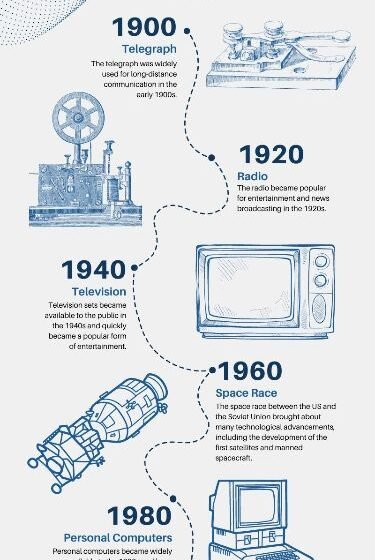
The 19th and early 20th centuries witnessed major advances in communication technology. The telegraph allowed messages to travel long distances far more quickly than traditional methods. The telephone later made real-time voice communication possible.
Radio and television expanded communication to mass audiences. These technologies transformed journalism, entertainment, education, business, and international communication.
The world was becoming increasingly connected, creating the foundations of today’s global communication networks.
8. The Birth of Modern Computers
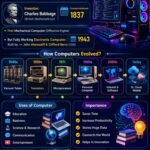
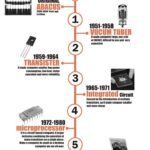
The development of electronic computers during the 20th century marked a major turning point in technological history. Early computers were extremely large machines primarily used for scientific calculations, military applications, and complex data processing.
The invention of the transistor in 1947 helped make computers smaller, faster, and more reliable. Integrated circuits and microprocessors later accelerated the development of personal computers.
By the 1980s and 1990s, computers were becoming increasingly common in homes, schools, offices, and businesses, beginning the transition toward a digital society.
9. The Internet Revolution
The Internet became one of the most transformative technologies in modern history. It changed how people communicate, access information, conduct business, study, and entertain themselves.
The World Wide Web made online information accessible to ordinary users. Websites, search engines, email, online shopping, and social media created an increasingly connected digital world.
The Internet also enabled businesses to operate globally and allowed people to communicate and share information across international borders almost instantly.
10. Smartphones and the Mobile Era
The rise of smartphones created another major technological transformation. Modern smartphones combine communication, photography, navigation, entertainment, computing, and online services in a single portable device.
Mobile applications have transformed banking, education, transportation, shopping, healthcare, and social interaction. High-speed mobile networks have made digital services accessible in more places than ever before.
The smartphone has effectively placed powerful computing technology into the hands of billions of people.
11. Cloud Computing and Big Data
Cloud computing changed how individuals and organizations store, manage, and process information. Instead of depending entirely on local computers, users can access applications, storage, and computing resources through the Internet.
At the same time, the rapid growth of digital services has generated enormous amounts of data. Big data technologies allow organizations to analyze this information and make more informed decisions.
Cloud computing and data analytics have become essential components of modern businesses, scientific research, education, and digital services.
12. Artificial Intelligence and Automation
Artificial intelligence is one of the most important developments in the modern technology timeline. AI systems can analyze information, recognize patterns, understand language, generate content, and assist with complex decision-making.
Machine learning, generative AI, robotics, and automation are increasingly influencing industries such as healthcare, finance, education, manufacturing, transportation, and software development.
Artificial intelligence represents a new stage in technological development because computers are becoming capable of performing increasingly sophisticated tasks that once required human intelligence.
13. The Future of Technology
The future of technology is likely to be shaped by rapidly developing fields such as artificial intelligence, quantum computing, biotechnology, advanced robotics, renewable energy, autonomous systems, and next-generation communication networks.
These technologies could improve healthcare, transportation, energy production, scientific research, communication, and many other areas of human life.
However, technological progress also creates challenges involving privacy, cybersecurity, employment, misinformation, and the responsible use of artificial intelligence. Future innovation will therefore require not only technical knowledge but also ethical responsibility.
Conclusion
The technology timeline demonstrates how human innovation has progressed from simple stone tools to sophisticated digital and intelligent systems. Every major technological breakthrough has influenced the development of the next generation, creating a continuous chain of innovation.
From fire and agriculture to electricity, computers, the Internet, smartphones, cloud computing, and artificial intelligence, technology has transformed the way humans live, work, communicate, and interact with the world.
The next chapter of technological history is already being written. As emerging technologies continue to develop, the future will depend on how wisely humanity chooses to use them.
Technology is not simply about creating powerful machines. It is about applying human creativity, knowledge, and innovation to build a more connected, productive, secure, and sustainable world.