
Meta Description: Discover how physical robotics is evolving in 2026, from AI-powered humanoid robots and smart factories to healthcare, agriculture, and autonomous machines.
Suggested URL Slug: physical-robotics-2026
Primary Keyword: Physical Robotics in 2026
Secondary Keywords: Physical AI, AI-powered robots, robotics technology, humanoid robots, autonomous robotics, industrial automation, future of robotics
Introduction
Physical robotics is becoming an important part of modern technology in 2026. By combining artificial intelligence (AI), advanced sensors, computer vision, machine learning, and mechanical engineering, robots are becoming more capable of interacting with the real world. They can recognize objects, navigate environments, assist workers, and perform tasks that once required constant human supervision.
Unlike traditional robots that follow fixed instructions, AI-powered robotic systems can use real-time information to adjust their actions to changing conditions. This development is closely connected to the rise of Physical AI, which enables machines to perceive their surroundings, make decisions, and act in the physical world. Industry analysis identifies this convergence of AI and robotics as a major technology trend in 2026.
In this article, we explore what physical robotics means, how it works, its major applications, its benefits and challenges, and what the future may hold.
What Is Physical Robotics?
Physical robotics is the field of designing, building, programming, and operating robots that interact with physical environments. These machines use hardware and software to move, sense their surroundings, manipulate objects, and complete specific tasks.
Physical robotics can include industrial robotic arms, autonomous mobile robots, agricultural robots, medical robots, drones, and humanoid robots.
When combined with artificial intelligence, physical robotics can become more adaptable. For example, a traditional robotic arm may be programmed to pick up an object from a fixed position. An AI-powered robot may use cameras and sensors to locate an object in a different position and adjust its movements accordingly.
This combination of physical hardware and intelligent software is helping robotics expand beyond repetitive factory operations into more complex environments.
How Does Physical Robotics Work?
Physical robotic systems rely on several technologies working together to perform tasks accurately and safely.
1. Artificial Intelligence and Machine Learning
Artificial intelligence helps robots interpret information, recognize patterns, and select suitable actions. Machine learning can help robotic systems improve their performance using training data and experience.
2. Sensors and Computer Vision
Cameras, depth sensors, lidar, and touch sensors provide information about the robot’s surroundings. Computer vision allows robots to identify objects, estimate distances, and recognize environmental changes.
3. Actuators and Mechanical Systems
Actuators are components that create movement. They control robotic joints, wheels, grippers, and other mechanical parts, allowing a robot to perform physical actions.
4. Robotics Software and Motion Planning
Robotics software translates decisions into movements. Motion-planning systems help robots choose paths, avoid obstacles, and coordinate their actions.
5. Real-Time Feedback
Robots continuously receive information from sensors and use feedback to adjust their movements. This process is essential when working with fragile objects, moving machinery, or changing environments.
Together, these components allow robots to connect digital intelligence with physical action.
Top Applications of Physical Robotics in 2026
1. Manufacturing and Industrial Automation
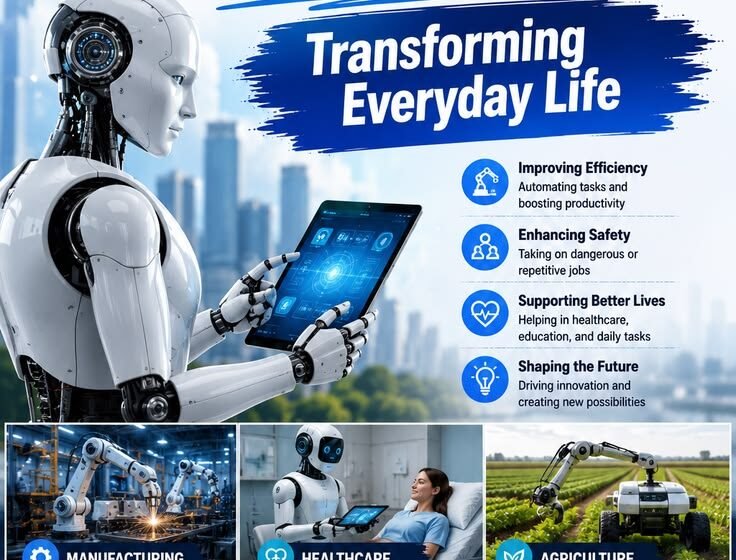
Manufacturing is one of the most established applications of physical robotics. Factories use robotic arms, automated inspection systems, and mobile robots to assemble products, move materials, and perform repetitive operations.
AI-enhanced robots can also support quality inspection by identifying visible defects and helping manufacturers maintain consistent production standards.
2. Healthcare and Medical Assistance
Robotics is supporting healthcare through surgical assistance, rehabilitation equipment, laboratory automation, and hospital logistics.
Robotic systems can help medical professionals perform specific procedures with precision and manage repetitive tasks. However, clinical applications require rigorous testing, appropriate supervision, and compliance with medical safety standards.
3. Agriculture and Smart Farming
Agriculture offers significant opportunities for physical robotics. Agricultural robots can assist with crop monitoring, targeted spraying, harvesting, planting, and weed detection.
When combined with computer vision and GPS-based navigation, these systems can help farmers monitor fields and apply resources more precisely. In the future, accessible agricultural robotics could become increasingly valuable for improving productivity and reducing unnecessary chemical use.
4. Warehousing and Logistics
Warehouses use autonomous mobile robots to transport goods, organize inventory, and move products between operational areas.
AI-enabled navigation helps these robots respond to obstacles and coordinate movement. These capabilities can improve material handling and support faster order fulfillment when properly integrated into warehouse operations.
5. Humanoid Robots
Humanoid robots are designed with body structures that resemble aspects of the human form. Some feature two legs, robotic arms, cameras, and advanced control systems.
The goal is to develop machines that can perform useful tasks in environments originally designed for people, including factories and warehouses.
However, reliable performance across a wide range of everyday tasks remains a major engineering challenge. Demonstrations of a robot performing one task do not necessarily prove that it can perform that task consistently at commercial scale.
6. Construction and Infrastructure
Robotic systems can support construction through automated surveying, material handling, inspection, and selected repetitive building operations.
Drones and inspection robots can also help examine bridges, pipelines, power facilities, and other infrastructure while reducing the need for people to enter certain hazardous areas.
The Role of Physical AI in Modern Robotics
Physical AI is one of the most important developments shaping robotics in 2026. It connects AI models with machines capable of acting in real-world environments.
Traditional AI often produces digital outputs, such as text, images, or predictions. Physical AI goes further by helping a robot interpret its surroundings and use that information to perform an action.
For example, an AI-powered warehouse robot might identify a package, estimate its position, plan a safe approach, pick it up, and move it to a designated location.
This process depends on more than an intelligent model. It also requires reliable hardware, high-quality training data, suitable control software, and safety mechanisms.
As these technologies develop, robots may become more flexible and useful in environments where conditions change frequently.
Key Benefits of Physical Robotics
Physical robotics offers several potential advantages across different industries.
- Improved productivity: Robots can perform suitable repetitive tasks efficiently.
- Greater precision: Automated systems can support consistent movements and measurements.
- Enhanced workplace safety: Robots can assist with hazardous, heavy, or difficult operations.
- Continuous operation: Properly designed systems can operate for extended periods with scheduled maintenance.
- Better resource management: AI-enabled robots can support more precise use of materials, energy, and agricultural inputs.
- Data-driven decisions: Sensors can collect operational information that helps organizations identify problems and improve workflows.
The actual benefits depend on the task, implementation costs, maintenance requirements, and the reliability of the robotic system.
Challenges Facing Physical Robotics
Despite its potential, physical robotics still faces several important challenges.
High Development and Deployment Costs
Robots may require expensive hardware, sensors, computing equipment, software integration, and ongoing maintenance. Smaller businesses may find these initial costs difficult to manage.
Safety and Reliability
A software error in a digital application may produce incorrect information, but a physical robot can cause damage or injury through an unsafe movement. Reliable safeguards, testing, emergency stops, and human oversight are essential.
Limited Adaptability
Robots can struggle with unfamiliar objects, unpredictable environments, delicate materials, and tasks that require complex physical judgment.
Data and Training Requirements
AI-powered robots need suitable real-world or simulated training data. Collecting high-quality data for physical tasks can be difficult, expensive, and time-consuming.
Workforce Training
As robotics adoption increases, workers may need new skills in robot programming, maintenance, automation, data analysis, and system supervision.
Physical Robotics vs. Traditional Robotics
| Feature | Traditional Robotics | AI-Powered Physical Robotics |
|---|---|---|
| Operation | Often follows predefined instructions | Can adapt using AI and sensor data |
| Environment | Usually structured and controlled | Can support more variable environments |
| Decision-making | Mostly rule-based | May use learned models and planning |
| Flexibility | Often limited to specific tasks | Potentially supports a wider range of tasks |
| Safety | Depends on design and controls | Requires safety controls plus AI validation |
These are general distinctions rather than absolute rules. Traditional robots can be highly sophisticated, and not every AI-powered robot can learn or adapt independently.
What Is the Future of Physical Robotics?
The future of physical robotics will likely depend on improvements in AI models, sensor technology, batteries, actuators, computing hardware, and robot training methods.
Several developments deserve attention:
- More adaptable robots: AI models may help robots handle a wider variety of objects and tasks.
- Human-robot collaboration: Robots may increasingly work alongside people in factories, hospitals, laboratories, and warehouses.
- Smarter agricultural machinery: Automated equipment could support precision farming, crop monitoring, and resource efficiency.
- Improved simulation: Virtual environments can help developers test robotic behaviors before deploying them in the real world.
- Coordinated robot fleets: Connected robots may share operational information and coordinate tasks more effectively.
- More accessible automation: Advances in hardware and software could make selected robotic applications practical for smaller businesses.
Progress will not be uniform across every industry. Cost, safety, regulation, infrastructure, and measurable business value will determine which applications become widely adopted.
How to Start Learning Physical Robotics in 2026
If you want to build a career or develop projects in physical robotics, start with the fundamentals.
- Learn programming: Begin with Python and gradually explore C++ for robotics applications.
- Study electronics: Understand sensors, motors, microcontrollers, and basic circuits.
- Learn robotics fundamentals: Study kinematics, control systems, motion planning, and feedback.
- Explore AI and computer vision: Learn how machines identify objects and interpret sensor data.
- Practice with simulation: Experiment with robotics simulation tools before investing in expensive hardware.
- Build small projects: Start with a line-following robot, obstacle-avoidance vehicle, or simple robotic arm.
- Develop safety skills: Learn how to test robots, manage mechanical risks, and design reliable controls.
Practical experience is essential because robotics combines software, electronics, mechanical engineering, and real-world problem-solving.
Conclusion
Physical robotics is helping transform the way people manufacture products, manage warehouses, support healthcare, and carry out agricultural and industrial work. In 2026, the combination of robotics and Physical AI is creating opportunities for machines to become more adaptable and capable of interacting with complex environments.
However, the future of robotics is not simply about building machines that look human or demonstrate impressive movements. The real measure of progress is whether robots can perform useful tasks safely, reliably, and economically.
For technology professionals, students, entrepreneurs, and businesses, physical robotics represents an important area to understand as AI increasingly moves from digital applications into the real world.