
Online privacy and cybersecurity have become more important than ever. Millions of people use the internet every day through smartphones, laptops, public Wi-Fi networks, and home connections. With growing concerns about data tracking, cyber threats, and online privacy, a VPN (Virtual Private Network) has become an important tool for many internet users.
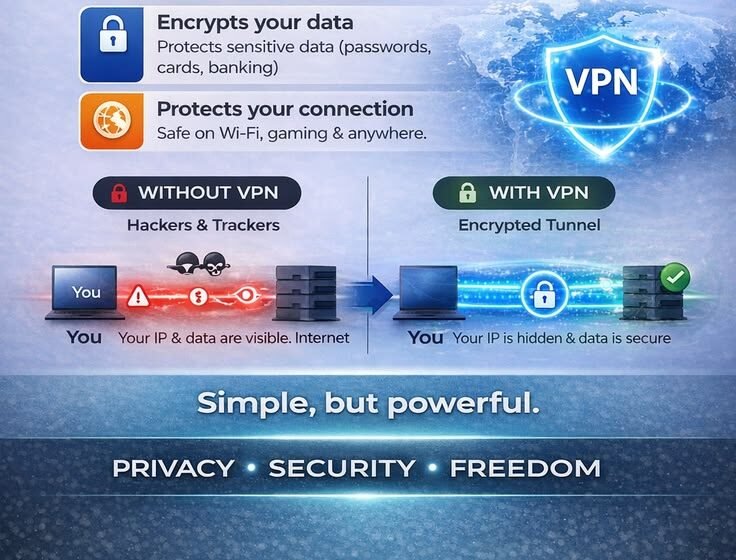
A VPN creates an encrypted connection between your device and a VPN server. It can also hide your real IP address from websites and online services, providing an additional layer of privacy and security while browsing the internet.
What Is a VPN?
VPN stands for Virtual Private Network. It is a technology designed to create a secure connection between your device and the internet.
Normally, your device connects directly to websites and online services through your internet provider. When you use a VPN, your internet traffic is routed through a VPN server before reaching its destination.
This process can help protect your data, hide your IP address, and improve privacy when using the internet.
How Does a VPN Work?
The basic process of a VPN is simple:
Your Device → Encrypted VPN Tunnel → VPN Server → Internet
When you connect to a VPN, your internet traffic travels through an encrypted tunnel to the VPN server. Websites generally see the IP address of the VPN server rather than your original IP address.
Encryption can make it significantly harder for unauthorized parties on the network to inspect your internet traffic.
Major Benefits of Using a VPN
1. Improved Online Privacy
One of the main reasons people use VPNs is to improve online privacy. A VPN can mask your IP address and make it more difficult for websites to associate your activity with your original network address.
However, a VPN does not provide complete anonymity. Your VPN provider may still process certain connection or account information depending on its policies.
2. Better Security on Public Wi-Fi
Public Wi-Fi networks at airports, hotels, cafes, and other locations can create security risks.
A VPN can encrypt your internet traffic and provide an additional layer of protection when using an unfamiliar network.
3. Secure Remote Access
Businesses and organizations often use VPN technology to provide employees with secure remote access to internal systems and resources.
This makes VPNs particularly useful for remote workers and organizations that need to protect sensitive business communications.
4. IP Address Masking
A VPN can replace your visible IP address with the IP address of the VPN server you connect to.
This can help reduce the amount of location information directly associated with your internet connection.
5. Access to Region-Specific Services
Some VPN providers operate servers in multiple countries. Connecting through a server in another region can change the apparent location of your internet connection.
However, websites and streaming platforms may restrict or block VPN connections, and users should always follow the terms and applicable laws associated with the service they are using.
Does a VPN Make You Completely Anonymous?
No.
This is one of the biggest misconceptions about VPN technology.
A VPN can improve privacy and hide your IP address from websites, but it does not make you completely anonymous online.
For example, if you log into an account using your real identity, the service can still associate your activity with that account. Your VPN provider may also collect certain information depending on its privacy policy.
For this reason, choosing a trustworthy VPN provider is extremely important.
Free VPN vs. Paid VPN
Many users are attracted to free VPN services because they do not require a subscription. However, free VPN services can come with limitations.
Some may offer fewer servers, slower speeds, limited bandwidth, or fewer security features. More importantly, users should carefully examine how a free VPN handles personal and usage data.
A reputable paid VPN may provide better performance, more server locations, stronger features, and clearer privacy practices.
Before choosing any VPN, users should research its privacy policy, reputation, security features, and independent reviews.
How to Choose the Best VPN in 2026
With hundreds of VPN services available, choosing the right one can be difficult.
Here are some important factors to consider:
- Strong encryption
- Transparent privacy policy
- Reliable logging practices
- Independent security audits
- Kill switch
- Fast connection speeds
- Large and reliable server network
- Multiple-device support
- Easy-to-use applications
- Responsive customer support
Do not choose a VPN simply because it has the largest number of servers. Security, privacy, reliability, and performance should be the main priorities.
What Is a VPN Kill Switch?
A VPN kill switch is an important security feature found in many modern VPN applications.
If your VPN connection unexpectedly drops, the kill switch can block internet traffic until the secure VPN connection is restored.
This can help prevent your real IP address or unprotected traffic from being exposed during an unexpected VPN disconnection.
Is a VPN the Same as Antivirus Software?
No.
A VPN and antivirus software serve different purposes.
A VPN primarily focuses on securing your internet connection and improving network privacy, while antivirus software is designed to detect and protect against malicious software such as viruses, spyware, and other threats.
For stronger overall security, users should combine a reputable VPN with other cybersecurity practices, including strong passwords, two-factor authentication, regular software updates, and careful browsing habits.
The Future of VPN Technology
VPN technology continues to evolve as internet privacy and cybersecurity become increasingly important.
Modern VPN providers are adding features such as tracker blocking, malware protection, phishing protection, advanced encryption technologies, and improved connection protocols.
The industry is also paying increasing attention to post-quantum security, as researchers prepare for future cryptographic challenges associated with quantum computing.
This means the VPN industry is likely to continue developing beyond traditional IP masking and basic encrypted connections.
Common VPN Mistakes to Avoid
Using a VPN does not automatically make someone safe from every online threat.
Users should avoid downloading VPN applications from unknown websites or installing suspicious APK files.
It is also important to keep VPN applications updated and use official sources whenever possible.
Another common mistake is assuming that a VPN can protect against phishing, malware, weak passwords, or account theft. A VPN is only one part of a complete cybersecurity strategy.
Final Verdict
A VPN can be a valuable tool for improving online privacy and security. It can encrypt internet traffic, mask your IP address, and provide additional protection when using public Wi-Fi networks.
However, not all VPN services are equal.
When choosing a VPN in 2026, users should focus on privacy policies, security features, independent audits, connection speed, reliability, and the reputation of the provider rather than simply choosing the cheapest service.
Ultimately, a VPN should be viewed as an important privacy and security tool—not a guarantee of complete anonymity.
With the right VPN and good cybersecurity habits, users can enjoy a safer, more private, and more secure online experience.