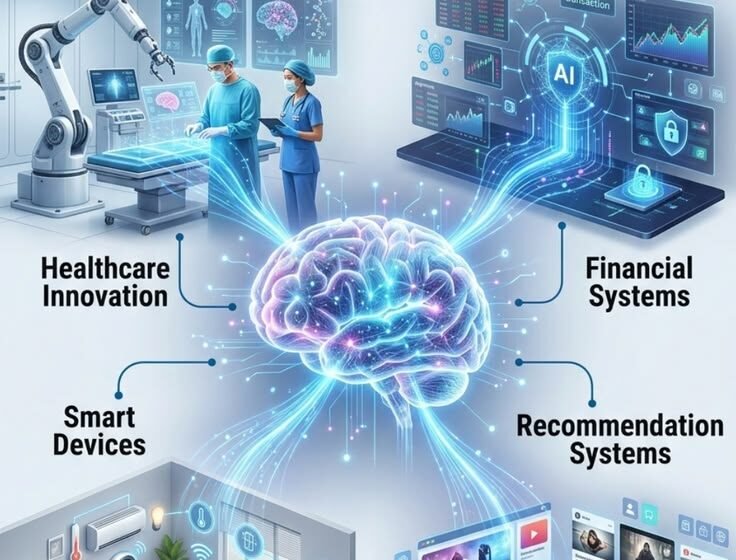

Machine Learning (ML) has become one of the most influential technologies in modern computing. From recommendation systems and fraud detection to autonomous technologies and AI-powered business tools, machine learning is changing how organizations use data and make decisions.
In 2026, machine learning is evolving rapidly through advances in Generative AI, AI agents, automation, edge computing, and responsible AI. As organizations collect and process increasingly large amounts of data, machine learning is becoming an essential component of modern digital infrastructure.
What Is Machine Learning?
Machine Learning is a branch of Artificial Intelligence that enables computers to learn patterns from data and improve their performance without being explicitly programmed for every individual task.
Instead of relying entirely on predefined rules, machine learning models analyze data, identify relationships, and use those patterns to generate predictions, classifications, or other outputs.
How Machine Learning Works
A typical machine learning system involves several important stages:
- Data Collection – Gathering relevant and reliable data.
- Data Preparation – Cleaning and organizing the information.
- Model Training – Teaching an algorithm to recognize patterns.
- Model Evaluation – Testing how accurately the model performs.
- Deployment – Integrating the trained model into a real-world application.
- Monitoring – Continuously evaluating and improving model performance.
The quality of the data and the design of the model can significantly affect the results.
Major Machine Learning Trends in 2026
1. Machine Learning and Generative AI
Machine learning is a fundamental technology behind modern Generative AI systems. Advanced models can process large amounts of information and generate text, images, audio, code, and other forms of content.
The growing combination of machine learning with generative models is expanding AI applications across technology, education, business, healthcare, finance, and creative industries.
2. AI Agents and Autonomous Systems
AI agents are increasingly combining machine learning with reasoning, tools, and automation. These systems can perform sequences of tasks and interact with software environments to accomplish specific objectives.
Machine learning plays an important role in enabling such systems to understand information and adapt their responses.
3. Edge Machine Learning
Traditional AI workloads often depend on centralized cloud infrastructure. Edge machine learning moves some processing closer to the device or location where data is generated.
This approach can be useful for applications that require rapid responses, including smart devices, industrial systems, robotics, and Internet of Things (IoT) applications.
4. Automated Machine Learning
Automated Machine Learning, commonly known as AutoML, helps simplify parts of the machine learning development process.
AutoML tools can assist with tasks such as model selection, feature engineering, and hyperparameter optimization, making machine learning more accessible to developers and organizations.
5. Responsible and Explainable AI
As machine learning becomes more important in business and society, organizations are paying greater attention to transparency, privacy, security, fairness, and accountability.
Explainable AI techniques can help users understand why a model produced a particular result, especially in applications where decisions require greater transparency.
Applications of Machine Learning
Machine learning is being used across a wide range of industries.
Business
Businesses use machine learning for customer analysis, demand forecasting, recommendation systems, fraud detection, and process automation.
Finance
Financial organizations can use ML models to analyze transactions, detect unusual activity, assess risks, and support forecasting.
Healthcare
Machine learning can assist with medical research, image analysis, patient-data analysis, and the development of predictive systems, subject to appropriate clinical and regulatory controls.
Cybersecurity
Machine learning can help identify unusual network behavior, detect potential threats, and analyze large volumes of security data.
E-Commerce
Online platforms use machine learning to personalize recommendations, understand customer behavior, optimize search results, and improve digital experiences.
Transportation
Machine learning supports applications such as traffic prediction, route optimization, predictive maintenance, and intelligent transportation systems.
Benefits of Machine Learning
Organizations can gain several advantages from well-designed machine learning systems:
- Data-driven insights
- Process automation
- Improved prediction
- Personalized user experiences
- Fraud and anomaly detection
- Operational efficiency
- Faster analysis of large datasets
However, these benefits depend on appropriate data, reliable models, proper implementation, and continuous monitoring.
Challenges of Machine Learning
Machine learning also comes with significant challenges. Poor-quality or biased data can affect model performance. Organizations must also consider privacy, cybersecurity, computational costs, model reliability, and the difficulty of explaining complex models.
Another important challenge is maintaining models after deployment. Data patterns can change over time, meaning a model that performs well today may require retraining or adjustment in the future.
The Future of Machine Learning
The future of machine learning will increasingly involve the integration of AI agents, Generative AI, cloud computing, edge computing, automation, and advanced data analytics.
Rather than operating as isolated technologies, machine learning systems are becoming part of broader AI platforms capable of processing information, generating content, supporting decisions, and automating complex workflows.
As the technology develops, the focus will increasingly shift toward building AI systems that are useful, secure, transparent, efficient, and reliable.
Conclusion
Machine Learning is one of the core technologies driving the evolution of Artificial Intelligence. Its ability to learn from data and identify patterns makes it valuable across industries ranging from finance and cybersecurity to e-commerce, transportation, and technology.
In 2026, the combination of machine learning with Generative AI, AI agents, automation, and edge computing is creating new possibilities for intelligent digital systems. For organizations and technology professionals, understanding machine learning is becoming increasingly important in a rapidly evolving AI-driven world.
Primary SEO Keyword: Machine Learning
Secondary Keywords: Machine Learning 2026, Machine Learning Technology, AI and Machine Learning, Machine Learning Trends, Future of Machine Learning, Generative AI, AI Agents, AutoML, Edge Machine Learning, Machine Learning Applications