
The history of computers is one of the most remarkable stories in the development of modern technology. Computers have transformed the way people work, communicate, learn, conduct business, and access information. From simple mechanical calculating devices to powerful artificial intelligence systems, computer technology has continuously evolved to become an essential part of everyday life.
Understanding the history of computers helps us see how technological innovation has shaped the modern digital world.
What Is a Computer?
A computer is an electronic device that processes data according to a set of instructions. It can perform calculations, store information, communicate with other devices, and complete complex tasks in a very short time.
Modern computers are used in almost every industry, including education, healthcare, banking, engineering, manufacturing, entertainment, and scientific research.
Early History of Computing
The history of computing began long before modern electronic computers were invented. Ancient civilizations developed tools to perform mathematical calculations more efficiently.
One of the earliest known calculating devices was the Abacus, which was used thousands of years ago in different parts of the world. It helped people perform basic arithmetic operations such as addition, subtraction, multiplication, and division.
Although the abacus was not a computer in the modern sense, it introduced the important concept of using a device to assist with calculations.
Mechanical Calculating Machines
During the 17th century, inventors began developing mechanical machines capable of performing mathematical calculations.
In 1642, French mathematician and inventor Blaise Pascal developed the Pascaline. It was a mechanical calculator designed to perform addition and subtraction.
Later, Gottfried Wilhelm Leibniz developed the Leibniz calculating machine, which could perform additional mathematical operations.
These inventions represented important steps toward automated computing.
Charles Babbage and the Analytical Engine
One of the most important figures in computer history is Charles Babbage, often associated with the development of the concept of a programmable computer.
In the 19th century, Babbage designed the Difference Engine, a mechanical machine intended to calculate mathematical tables.
He later designed the Analytical Engine, which was much more advanced. It included concepts similar to components found in modern computers, such as memory, processing, input, and output.
Although the complete Analytical Engine was never constructed during Babbage’s lifetime, its design became an important foundation for the development of programmable computing.
Ada Lovelace and Early Computer Programming
Ada Lovelace is another important figure in the history of computers. She worked with Charles Babbage and wrote detailed notes about the Analytical Engine.
Her work included an algorithm intended for the machine, and she is widely recognized as an early pioneer of computer programming.
Her ideas demonstrated that computing machines could potentially do more than simple calculations.
The Beginning of Electronic Computers
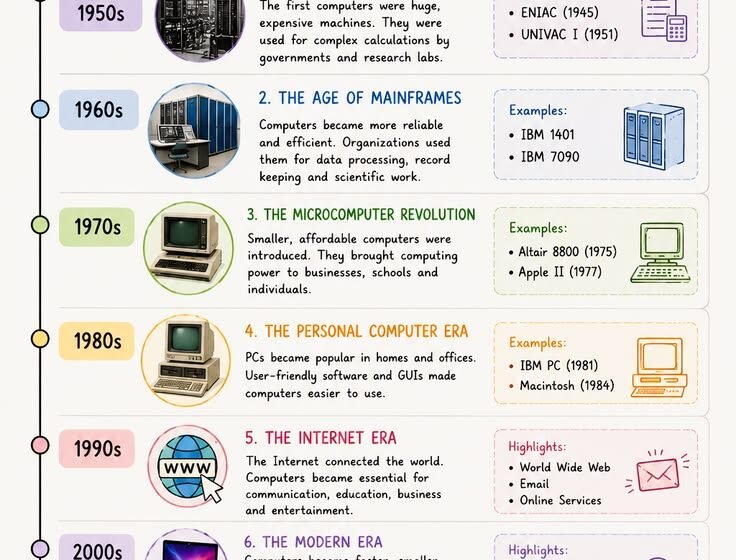
The development of electronic computers accelerated during the 20th century. Researchers began replacing mechanical components with electronic systems, making computers faster and more powerful.
During the 1940s, several large electronic computing machines were developed for scientific and military purposes.
One famous example was ENIAC, an early general-purpose electronic computer. It was extremely large compared with today’s computers and used thousands of vacuum tubes.
These early machines demonstrated the enormous potential of electronic computing.
First Generation of Computers
The first generation of computers generally refers to computers developed during the 1940s and 1950s that relied heavily on vacuum tubes.
These computers were very large, expensive, and consumed significant amounts of electricity. They also produced considerable heat and required specialized environments.
Despite these limitations, first-generation computers established the foundation for electronic digital computing.
Second Generation: The Transistor Era
During the late 1950s and 1960s, transistors began replacing vacuum tubes.
Transistors were smaller, more reliable, consumed less power, and generated less heat. As a result, computers became smaller, faster, and more dependable.
This technological change marked a major step forward in computer history.
Third Generation: Integrated Circuits
The next major development came with the introduction of integrated circuits (ICs).
Instead of using individual electronic components separately, multiple components could be placed onto a single semiconductor chip. This allowed computers to become smaller and more powerful.
During this period, computers became increasingly useful for businesses, universities, government organizations, and scientific research.
Fourth Generation: Microprocessors and Personal Computers
The invention and development of the microprocessor revolutionized the computer industry.
A microprocessor placed the central processing functions of a computer onto a single chip. This made it possible to develop much smaller and more affordable computers.
During the 1970s and 1980s, personal computers began becoming increasingly popular. Companies such as Apple and IBM played important roles in bringing personal computing to consumers and businesses.
The personal computer changed the way people performed office work, education, communication, and entertainment.
The Rise of the Internet
Another major milestone in computer history was the development and expansion of the Internet.
Initially developed through research networks, the Internet eventually became a global communication system. The introduction of the World Wide Web made online information much easier for ordinary users to access.
As Internet access expanded, computers became powerful tools for communication, online education, digital business, entertainment, and information sharing.
The Mobile Computing Revolution
The development of laptops, smartphones, and tablets changed computing once again.
People no longer needed to stay at a desk to access digital information. Portable devices allowed users to communicate, browse the Internet, manage businesses, take photographs, watch videos, and use applications from almost anywhere.
Smartphones eventually combined computing, communication, cameras, navigation, entertainment, and many other technologies into a single device.
Modern Computers and Cloud Computing
Today, computers are significantly more powerful than early machines while being dramatically smaller and more energy efficient.
Modern computing includes technologies such as:
- Cloud computing
- High-performance computing
- Artificial intelligence
- Machine learning
- Quantum computing research
- Internet of Things (IoT)
- Advanced cybersecurity
- Edge computing
Cloud computing has also changed how people store and access information. Instead of keeping everything on a local computer, users and organizations can access applications and data through Internet-connected services.
Artificial Intelligence and the Future of Computing
Artificial intelligence represents another major stage in the evolution of computing.
Modern AI systems can analyze large amounts of data, recognize patterns, understand natural language, generate content, assist with software development, and support decision-making in many industries.
The future of computing is likely to involve increasingly intelligent systems, more specialized processors, advanced robotics, quantum computing, and closer integration between humans and digital technologies.
Conclusion
The history of computers is a journey from simple calculation tools to highly advanced digital systems capable of processing enormous amounts of information.
The development of mechanical calculators, electronic computers, transistors, integrated circuits, microprocessors, personal computers, the Internet, smartphones, cloud computing, and artificial intelligence has transformed society.
As technology continues to advance, computers will remain one of the most important technologies shaping the future of communication, business, science, education, and everyday life.