
Artificial Intelligence (AI) has become one of the most important technologies of the modern digital era. From virtual assistants and recommendation systems to generative AI and autonomous machines, artificial intelligence is transforming the way people work, communicate, learn, and solve problems.
However, AI is not a new concept. Its development has taken decades of research, experimentation, innovation, and technological progress. Understanding the history of artificial intelligence helps explain how early ideas about intelligent machines eventually evolved into today’s powerful AI systems.
What Is Artificial Intelligence?
Artificial Intelligence refers to the development of computer systems that can perform tasks normally associated with human intelligence. These tasks may include learning, reasoning, understanding language, recognizing images, solving problems, and making predictions.
Modern AI is powered by technologies such as machine learning, deep learning, neural networks, natural language processing, and generative AI.
The Early Ideas Behind AI
The idea of creating artificial or mechanical intelligence dates back centuries. Ancient civilizations developed stories and concepts involving artificial beings that could perform tasks or behave like humans.
The scientific foundation for modern AI became stronger during the 19th and early 20th centuries as mathematicians and scientists developed formal systems for logic, computation, and information processing.
The invention of modern computers eventually made it possible to explore whether machines could perform intelligent tasks.
Alan Turing and the Foundations of Machine Intelligence
One of the most influential figures in the early history of AI was British mathematician and computer scientist Alan Turing.
In 1950, Turing published his influential paper Computing Machinery and Intelligence. He explored the question of whether machines could demonstrate intelligent behavior and introduced what became known as the Turing Test.
Turing’s work helped establish an important foundation for the scientific study of machine intelligence.
The Birth of Artificial Intelligence in the 1950s
The term Artificial Intelligence became associated with a formal research field in the 1950s.
In 1956, the Dartmouth Summer Research Project on Artificial Intelligence brought together researchers interested in machine intelligence. The workshop is widely regarded as a major milestone in the establishment of AI as an academic research field.
Researchers became increasingly interested in creating machines capable of reasoning, problem-solving, and learning.
AI Research During the 1960s and 1970s
During the 1960s and 1970s, researchers developed early AI programs capable of solving mathematical problems, playing games, processing language, and demonstrating limited forms of reasoning.
Early systems often relied heavily on rules and symbolic logic. Researchers believed that many aspects of human intelligence could be represented using formal rules and knowledge.
However, computers at the time had limited processing power and memory, creating significant challenges.
The Rise of Expert Systems
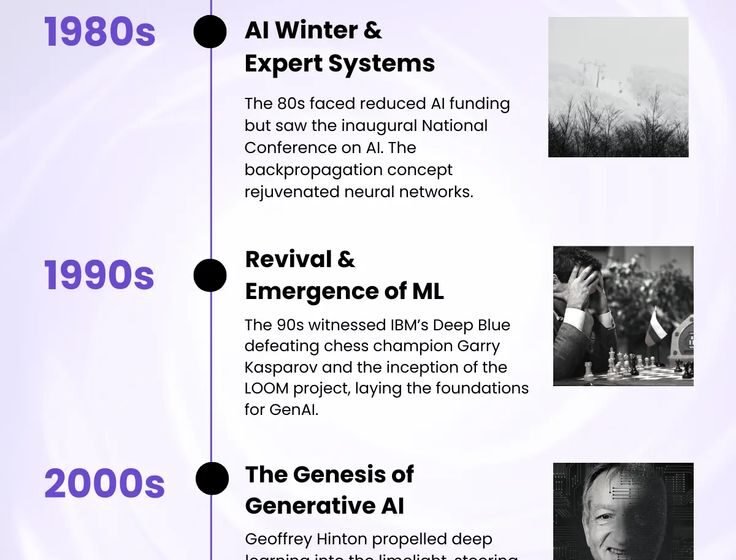
During the 1970s and 1980s, expert systems became an important area of AI research.
Expert systems were designed to use a collection of rules and specialized knowledge to solve problems in specific fields. They were used in areas such as medicine, engineering, and business decision-making.
These systems demonstrated that AI could provide useful solutions in specialized environments, although they were generally limited to the knowledge and rules programmed into them.
AI Winters
The history of AI has not always been a continuous success story. There were periods when interest and investment in AI declined, often referred to as AI winters.
During these periods, researchers faced technical limitations, high costs, unrealistic expectations, and disappointing results. Funding and public enthusiasm decreased as some AI projects failed to meet expectations.
These setbacks nevertheless encouraged researchers to develop new approaches and improve the foundations of AI.
Machine Learning Changes AI
A major transformation occurred as researchers increasingly focused on machine learning.
Instead of programming every rule manually, machine learning systems could learn patterns from data. This approach allowed computers to improve their performance on certain tasks by analyzing large amounts of information.
As computing power increased and more digital data became available, machine learning became increasingly practical.
The Rise of Neural Networks and Deep Learning
Neural networks became another major turning point in AI development.
Inspired loosely by the structure of biological neural systems, artificial neural networks use interconnected computational units to identify patterns in data.
The development of deep learning enabled neural networks with many layers to process increasingly complex information. Advances in specialized hardware, large datasets, and improved algorithms helped deep learning achieve major breakthroughs in areas such as image recognition, speech recognition, and natural language processing.
AI Breakthroughs in the 2010s
The 2010s were a particularly important decade for artificial intelligence.
AI systems achieved impressive results in areas including computer vision, speech recognition, language processing, and strategic games. In 2016, Google’s DeepMind system AlphaGo defeated world champion Go player Lee Sedol, demonstrating the potential of modern deep learning and reinforcement learning.
During this period, AI also became increasingly integrated into consumer products and online services.
The Era of Generative AI
The next major transformation came with generative AI.
Generative AI systems can create new content, including text, images, audio, video, and computer code. Large language models became particularly important because they enabled computers to generate and understand human-like language at an unprecedented scale.
The rapid growth of generative AI has expanded the use of artificial intelligence from specialized applications to everyday tasks such as writing, research, programming, education, customer service, and content creation.
AI Agents and the Next Stage of AI
By 2026, AI development is increasingly moving beyond simple question-and-answer systems toward more capable AI agents.
AI agents are designed to understand objectives, plan tasks, use digital tools, interact with software, and complete multi-step workflows with varying levels of human supervision.
This evolution could make AI increasingly useful for businesses, developers, researchers, and everyday users.
How AI Has Evolved
The development of artificial intelligence can be broadly understood through several stages:
- Early theoretical ideas – Concepts of mechanical and artificial intelligence.
- Foundations of computing – Development of mathematical logic and programmable computers.
- Birth of AI research – Formal AI research emerged during the 1950s.
- Symbolic AI and expert systems – Rules and knowledge-based systems became prominent.
- Machine learning – Systems increasingly learned patterns from data.
- Deep learning – Neural networks became capable of handling complex tasks at scale.
- Generative AI – AI began creating human-like content.
- AI agents – AI systems increasingly perform multi-step tasks using tools and software.
The Future of Artificial Intelligence
The future of AI is likely to involve increasingly capable systems that can work across multiple types of information and perform more complex tasks.
AI is expected to continue influencing industries such as healthcare, education, finance, cybersecurity, manufacturing, transportation, software development, and digital media.
At the same time, important issues such as privacy, security, misinformation, copyright, employment, transparency, and responsible AI development will remain central to discussions about the technology.
Conclusion
The history of artificial intelligence is a story of decades of research, experimentation, setbacks, and breakthroughs. From early theories of machine intelligence and Alan Turing’s foundational work to machine learning, deep learning, generative AI, and modern AI agents, the technology has evolved dramatically.
AI has moved from research laboratories into everyday life and has become a major part of the modern technology ecosystem. As research continues, the next generation of AI may further change how people interact with computers and use technology to solve complex problems.
Understanding the history of AI provides valuable context for understanding where artificial intelligence is today—and how it may continue to evolve in the years ahead.