
Introduction
Artificial Intelligence (AI) has become one of the most influential technologies of the modern world. From virtual assistants and intelligent search engines to self-driving vehicles and generative AI tools, artificial intelligence is transforming how people live, work, learn, and communicate. However, AI did not develop overnight. Its history spans decades of scientific research, technological breakthroughs, and innovative ideas.
Understanding the history of artificial intelligence helps us explore how early computing concepts evolved into the powerful AI systems we use today. This article covers the major milestones in AI development, from its theoretical foundations to the advanced technologies shaping 2026.
What Is Artificial Intelligence?
Artificial Intelligence is a branch of computer science focused on developing systems that can perform tasks commonly associated with human intelligence. These tasks include learning, reasoning, problem-solving, understanding language, recognizing images, and making predictions.
AI systems use different techniques, including machine learning, deep learning, natural language processing, and computer vision, to analyze information and perform specific tasks. Modern AI applications are used in healthcare, education, business, cybersecurity, transportation, and many other industries.
1. The Early Foundations of AI
The origins of artificial intelligence can be traced to early philosophical discussions about reasoning, logic, and intelligent machines. For centuries, thinkers explored whether human reasoning could be represented through formal rules.
During the 20th century, advances in mathematics and computing brought these ideas closer to reality. In 1950, British mathematician Alan Turing published his influential paper, Computing Machinery and Intelligence. He introduced the question of whether machines could demonstrate intelligent behavior and proposed what later became known as the Turing Test.
Turing’s work helped establish important foundations for modern AI research.
2. The Birth of Artificial Intelligence in 1956
The year 1956 is widely recognized as a major turning point in AI history. At the Dartmouth Summer Research Project on Artificial Intelligence, researchers gathered to explore whether aspects of human intelligence could be described precisely enough for machines to simulate them.
The term “artificial intelligence” is associated with this research project and its organizer, John McCarthy, who became one of the field’s pioneering researchers.
Early AI researchers developed programs that could solve mathematical problems, manipulate symbols, and perform logical reasoning. These achievements created optimism that machines might eventually perform a much wider range of intellectual tasks.
3. Early AI Progress During the 1960s and 1970s
During the 1960s and 1970s, researchers developed programs for problem-solving, language processing, and basic forms of machine interaction.
Some early systems demonstrated that computers could solve carefully defined problems and follow logical rules. Researchers also experimented with robots and programs designed to understand limited forms of human language.
However, these systems faced significant limitations. Computers had limited processing power, data was scarce, and real-world problems were often much more complicated than laboratory experiments.
As expectations exceeded the available technology, funding and interest declined during periods commonly known as AI winters.
4. Expert Systems and the Growth of AI in the 1980s
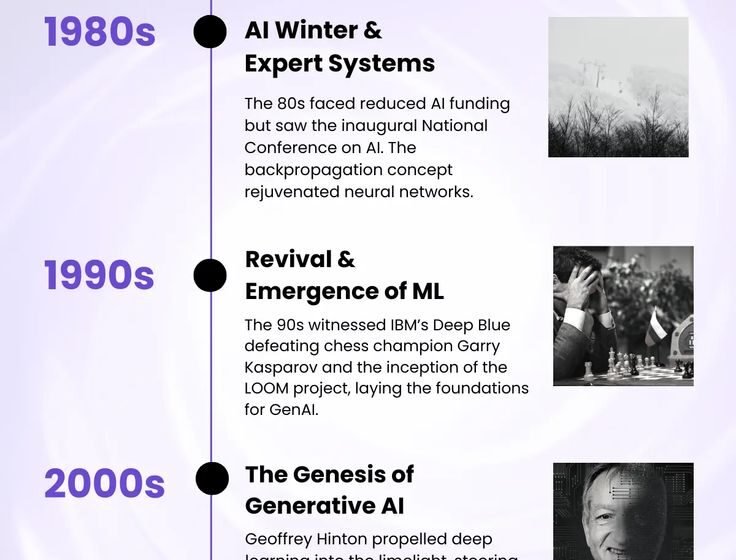
Artificial intelligence gained renewed attention during the 1980s through the development of expert systems. These systems used human-defined rules and specialized knowledge to help solve problems in specific fields.
Businesses and organizations explored expert systems for activities such as equipment troubleshooting, medical decision support, and industrial planning.
Although expert systems demonstrated the commercial potential of AI, they were expensive to maintain and struggled when situations fell outside their programmed rules. These limitations contributed to another decline in AI investment and enthusiasm.
5. Machine Learning Changes AI Development
During the 1990s and 2000s, machine learning became increasingly important in artificial intelligence research. Instead of relying entirely on manually programmed rules, machine learning systems could identify patterns in data and improve their performance through training.
The growth of the internet, improved computer hardware, and larger digital datasets helped accelerate this shift.
A notable milestone occurred in 1997 when IBM’s Deep Blue defeated world chess champion Garry Kasparov in a match under standard tournament conditions. This achievement demonstrated the power of specialized computing and search algorithms, although it did not mean that the computer possessed general human-like intelligence.
Machine learning subsequently became an important part of search engines, recommendation systems, fraud detection, and speech recognition.
6. The Deep Learning Revolution
During the 2010s, deep learning significantly advanced the capabilities of artificial intelligence. Deep learning uses multi-layered neural networks to learn complex patterns from large amounts of data.
In 2012, the AlexNet neural network achieved a breakthrough in the ImageNet image-recognition competition, helping popularize deep learning for computer vision.
Further developments improved speech recognition, image classification, language translation, and other AI applications. Powerful graphics processing units (GPUs), large datasets, and improved algorithms made it possible to train increasingly capable models.
AI began moving from specialized research environments into everyday products and services.
7. The Rise of Generative AI
Generative AI became a major technological development in the 2020s. Unlike systems designed only to classify information or make predictions, generative AI models can produce new content, including text, images, audio, video, and computer code.
The introduction of ChatGPT in November 2022 brought conversational AI to a much wider audience. People began using AI assistants for writing, learning, brainstorming, programming, research, and productivity.
Image-generation systems and other generative tools also expanded creative possibilities for designers, developers, marketers, and content creators.
Despite these advances, generative AI can produce inaccurate information, reflect biases in training data, and raise concerns about privacy, copyright, and misinformation. Human review remains important when accuracy and accountability matter.
8. Artificial Intelligence in 2026
By 2026, artificial intelligence has become an important part of digital transformation across numerous industries. AI tools are increasingly used to support professional tasks, automate workflows, analyze complex information, and improve customer experiences.
Several important developments are shaping the current AI landscape:
AI Agents: AI agents can work toward defined goals by carrying out multiple steps, using available tools, and interacting with digital systems under appropriate permissions.
Multimodal AI: These systems can process combinations of text, images, audio, and other data types, enabling more flexible interactions.
AI in Healthcare: AI supports medical research, image analysis, administrative tasks, and clinical decision-support workflows, with appropriate professional oversight.
AI-Powered Cybersecurity: Security teams use AI to identify suspicious patterns, prioritize alerts, and respond to potential threats.
AI in Education: AI-powered learning tools can help explain concepts, generate practice exercises, and adapt learning support to individual needs.
Responsible AI: Developers and organizations increasingly need to consider transparency, privacy, fairness, security, reliability, and human oversight when deploying AI systems.
These developments highlight how artificial intelligence is evolving from a specialized computing discipline into a broad technology used across everyday life and professional environments.
9. Challenges and Ethical Concerns in AI
Although AI offers significant opportunities, its development also creates important challenges. Understanding these issues is essential for using AI responsibly.
Key concerns include:
- Data privacy: AI systems may process sensitive information that requires appropriate protection.
- Bias and fairness: Biased training data can lead to unfair or inaccurate outcomes.
- Misinformation: AI-generated content can be convincing even when it is incorrect.
- Employment changes: Automation may transform job responsibilities and increase demand for new skills.
- Security risks: AI can be misused for fraud, impersonation, and other harmful activities.
- Transparency and accountability: Organizations need clear processes for evaluating AI decisions and addressing failures.
Responsible AI development requires technical safeguards, appropriate regulation, human judgment, and ongoing evaluation.
10. What Is the Future of Artificial Intelligence?
The future of AI will likely involve more capable assistants, improved reasoning, personalized digital services, and deeper integration with business software and physical devices.
Researchers are working to improve the reliability, efficiency, and usefulness of AI systems. Future developments may help scientists accelerate research, support more accessible education, improve industrial processes, and solve complex problems.
However, progress is not guaranteed to be uniform. Technical limitations, computing costs, safety concerns, and regulatory requirements will influence how quickly new AI capabilities become widely available.
The most valuable future applications will combine technological innovation with human expertise, responsible decision-making, and practical benefits.
Conclusion
The history of artificial intelligence reflects decades of curiosity, experimentation, setbacks, and remarkable progress. From Alan Turing’s early questions about machine intelligence to the development of machine learning, deep learning, and generative AI, each stage has contributed to today’s technological landscape.
In 2026, artificial intelligence continues to reshape industries and create new opportunities for individuals and businesses. At the same time, accuracy, privacy, fairness, and responsible use remain essential.
Understanding AI’s history provides a clearer perspective on its present capabilities and future possibilities. As technology continues to advance, artificial intelligence is likely to remain one of the most important areas of innovation in the digital age.
Frequently Asked Questions (FAQs)
When did artificial intelligence begin?
AI became an established research field in 1956 at the Dartmouth Summer Research Project, although many of its theoretical foundations developed earlier.
Who is known as the father of artificial intelligence?
John McCarthy is widely known as one of the fathers of AI and is credited with introducing the term “artificial intelligence” in connection with the 1956 Dartmouth project.
What was the first major breakthrough in AI?
There was no single first breakthrough. Early advances included programs for logical reasoning and problem-solving. Later milestones included expert systems, Deep Blue, deep learning, and generative AI.
How has AI changed over time?
AI has evolved from rule-based programs and specialized systems to machine learning, deep neural networks, and generative models capable of producing content and assisting with complex tasks.
Why is artificial intelligence important in 2026?
AI helps people and organizations analyze information, automate selected tasks, support decision-making, improve productivity, and develop new digital services.
What is the future of AI?
AI is expected to continue advancing in areas such as AI agents, multimodal systems, scientific research, robotics, education, and business automation, while reliability and responsible use remain major priorities.